

Surfski.info Review: EOS 660
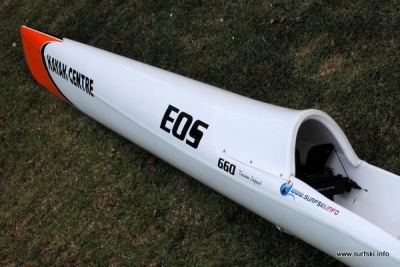 Kayak Centre EOS 660
Credits: www.surfski.info
Kayak Centre EOS 660
Credits: www.surfski.info
Fast – but not for the faint hearted... We’ve been paddling the EOS 660 from Kayak Centre. Here’s the Surfski.info review.
First Looks
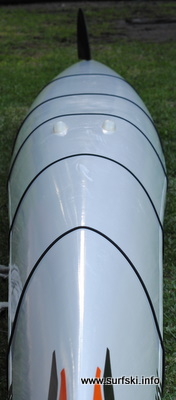
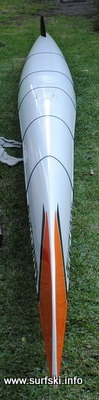
The most noticeable thing about the EOS 660 is of course that hump in front of the cockpit. Trying it out in surf, I can confirm that the hood effectively reduces the amount of water that gets into the cockpit. It’s not such an important factor here in Cape Town where we seldom race out through surf – but it is a nice feature to have in places where surf launches are a matter of course.



The skis (we played with both carbon and glass layup versions) are beautifully finished; there’s great attention to detail and the components used (footplate rails; tiller bar; rudder pedals) are high quality.
The ski is long – 6.60m (hence the 660). It is flat (20mm more rocker than the Red7 Surf70 Pro and 40-50mm less rocker than the Fenn Mako Elite.)
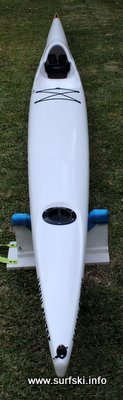
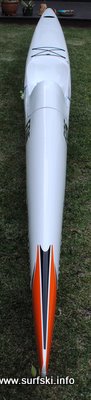
The carbon ski had some updates, see below
Footplate Adjustment
Adjusting the footplate position is extremely quick and easy – the rudder lines are self-adjusting and the footplate catches are released by means of a lever. Press the lever to one side, the catches are released. Push the footplate to the new position and the sprung catches re-engage. Simple and easy to use.
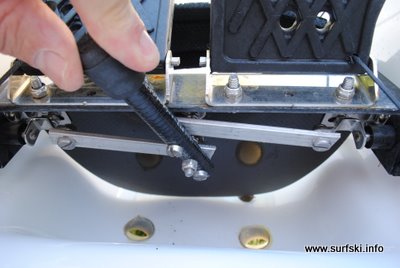
A simple lever mechanism makes it easy to release the footplate catches
Paddling the EOS 660
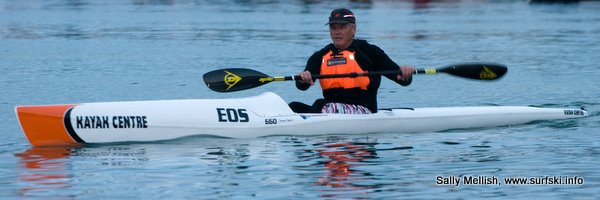
Dale Lippstreu, before heading out for a paddle in Hout Bay
Comfort
The paddling position is very comfortable – and feels higher than some other skis (like my Mako Elite for example. It’s not as high as the Nelo seat however!)
I found my coccyx being rubbed by the bucket, so I fitted my trusty Lincke Kayaks bum pad. (The pad has Velcro sewn onto its nylon cover and all you have to do is put two small pieces of self-adhesive Velcro into the bottom of the bucket.)
Flat Water
The carbon ski was on its way to the USA and I only had the chance to paddle it once. We did a 16km circuit in False Bay on a flat day. There was a light breeze coming from the south so we had a small amount of side-on chop; absolutely flat water as we paddled through the Simonstown yacht marina, some small head-on chop; some more side-on and a run back to the finish in Fish Hoek on small downwind runs.
My first impressions were that although the ski felt a little frisky, it also felt fast. It seems to glide along very easily on flat water.
The best way to judge a new ski of course is to paddle against your regular paddling partners – and I had two of them with me. We normally have a great dice between the three of us. I was able to paddle alongside them very comfortably and it seemed to me that when it was my turn, I was able to pull the group easily; perhaps more easily than normal.
When we turned downwind, the ski seemed to pick up the small bumps very readily and to stay on them.
Choppy Water/Small Downwind Conditions
A few days later I had the opportunity to try the glass ski in more challenging conditions. We have a delightful downwind route called the Millers Run here in Cape Town, which we paddle whenever the southeaster blows. In winter, when we have prevailing northwesters, we paddle it in reverse – the “Reverse Millers”. On this particular day the wind was blowing more west (offshore) than northwest so it wasn’t an ideal day for it – let the wind blow you past the finish at Millers Point and it’s next stop South Atlantic!
While the others took the direct route I took a more cautious line and headed across in the direction of Simonstown before turning downwind. Although I’d chosen a good line, the waves and wind were still coming at a 45 degree angle over my right shoulder. I was impressed with the ability of the ski a) to catch the small runs and b) to hold its line. I had half expected to be broaching a lot in the short steep wind chop, but the ski was very controllable.
As we approached Millers Point the wind increased in speed, blowing sheets of spray off the surface of the water. In addition huge ocean swells were coming towards us, and there were massive breakers smashing over the rocks. Usually we navigate between the rocks before turning sharp right, broadside to the wind to paddle into the ramp – but not today. This time we had to go right out and around the point, leaving us with a long side-on paddle in. Just to add to the excitement there was a sizeable shore break at the ramp; timing was critical to avoid being smashed either onto the ramp itself or onto the boulder-strewn shore.
We all made it in one piece. And I was left with feeling that the ski was handle-able even in pretty extreme conditions. I couldn’t gauge the speed however since I paddled effectively on my own and had none of my usual markers to judge by.
Big, Messy Downwind
I met my match a few days later however in a southeaster when we did a proper Millers run – from Millers Point to Fish Hoek. Conditions were classic for this time of year. Nice runs, but technical with chop swirling from the side.
To my surprise I felt quite tippy in the ski. Although I was catching runs, the ski kept being knocked about by the confused sea and I felt increasingly unstable and unsure of myself.
The sun was already setting and the water was very cold (around 14C) so I was highly motivated not to fall in.
At the lighthouse I stopped to wait for my buddy, turned side-on to the waves to look for him and found myself fighting to stay upright, to the point that I could hardly snatch a stroke or two to get the ski moving forward so that I could turn downwind. Shaken, I paddled very conservatively back to Fish Hoek.
My impressions:
- In spite of the chaotic sea, the ski would launch onto the runs very readily.
- In the big sea conditions it didn’t seem to nose dive excessively and didn’t seem to decelerate when it did.
- The drainage was good; the ski is equipped with the Red7 bullet scuppers. (I rate these highly and have equipped my Mako Elite with them.)
- I broached a couple of times but not abnormally so – any ski will broach if you’re not up to speed when a wave comes under you.
But, I found the ski a handful in the gnarly waves.
Short, steep downwind chop
Sometime later the opportunity arrived to take the ski on a proper reverse Millers Run. I took my Mako Elite and my regular paddling partner Dale Lippstreu took the EOS. We agreed to paddle together to the lighthouse and then race the second half of the route down to Millers Point.
Dale found that in these specific conditions, the ski seemed to dip its nose and get stuck behind the next wave and he couldn’t stay with me. The ski has a fair amount of volume in the tail and we theorise that this was picking the back of the ski up and not letting it pop over the next wave.
Smaller runs...
But we paddled together several times in smaller runs both in False Bay and Hout Bay and Dale was able to drop me, seeming to stay on the runs longer and in these conditions we felt that it was perhaps the flatter rocker of the EOS that was the difference.
Big, clean swell?
Winter in Cape Town is not conducive to safe, big ocean conditions and we never had the opportunity to try the ski in such conditions. However, we will have another ski to try in a couple of weeks and as soon as we do have an opportunity to try it, we'll update this review.
Upwind Paddling
We did a Vulcan Run (4km out into the open Atlantic from Hout Bay to Vulcan Rock and back) in rough conditions and I put another paddling buddy, Jurgen Geitner on the EOS. It was striking how he was able to put the hammer down into the wind and drop the rest of us. Jurgen currently paddles a Fenn Millenium and so is used to tippy skis.
We all remarked on how quiet the ski is going into chop – it seems to slice through the waves very cleanly without slapping.
(Jurgen dropped back initially when we turned downwind, but after a while seemed to adapt to the ski, caught up and dropped us again.)
Remounting
I did fall off the ski - on flat water (in Shark Alley next to Fish Hoek just as I was telling the story of the last sharky episode when a ski was bitten by a Great White!). Being quite highly motivated, I got back on the ski fairly quickly.
I also tried it on bouncy water after a downwind run.
Being unused to it, I found the hood disconcerting – I’m used to grabbing the footstrap and paddle together during the remount. On the other hand the relatively shallow bucket aids the process. Overall I don’t think the ski is any more difficult to remount than others – but it’s advisable to give it a go before setting out for your first hectic downwind!
What I like about the ski
- The finish
- The weight
- The manoeuvrability on flat water
- The (feeling of) speed going upwind and on flat water
- The way the ski seems to persist on small runs
What I don’t like
- The feeling of tippiness in big confused water
- The seat – it rubs my coccyx raw. This is a personal thing, but more and more skis seem to have buckets that are more comfortable (for me) these days. A bum pad fixes the problem.
In Summary
This is a top of the range ski. It’s well built, and fast.
But it’s not for paddlers who have iffy balance. I would not like to take it on a big gnarly downwind paddle – but I’m a mid-packer and there are plenty of paddlers with better balance than me who would have a ball in any conditions on the ski.
After having paddled this ski, my buddy Dale ordered one (and has had it equipped with the PCR rudder... Watch this space!)
Updates
As noted earlier, the carbon version of the EOS 660 that we played with for a day had some improvements which are now standard on all the skis. These are:
- A solid leash anchor point
- Recessed bungy cords on the rear deck
- A new bung with incorporated breather hole – moved from the tail to the cockpit front bulkhead.
- And new anodised aluminium rudder components (shaft/tiller bar) which makes for a stunning, incredibly light rudder assembly
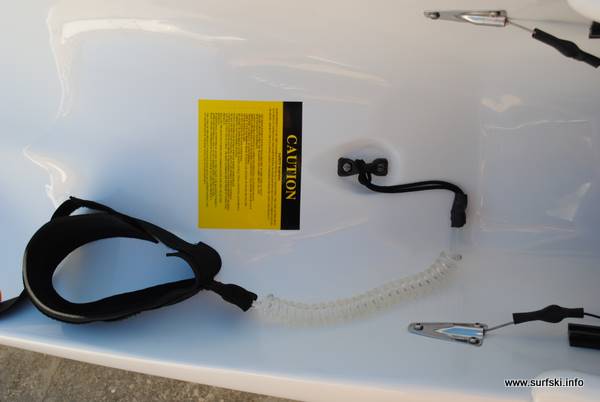
Leash anchor
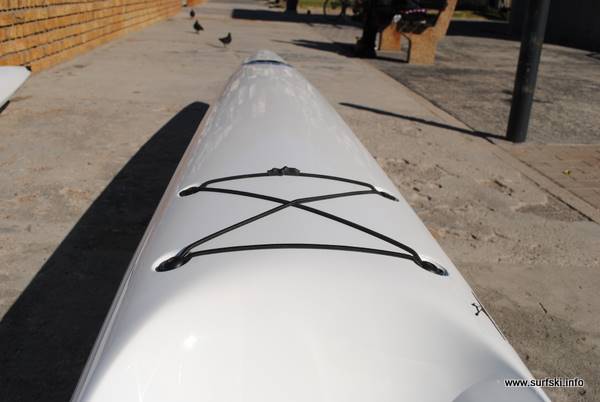
Recessed bungy cords
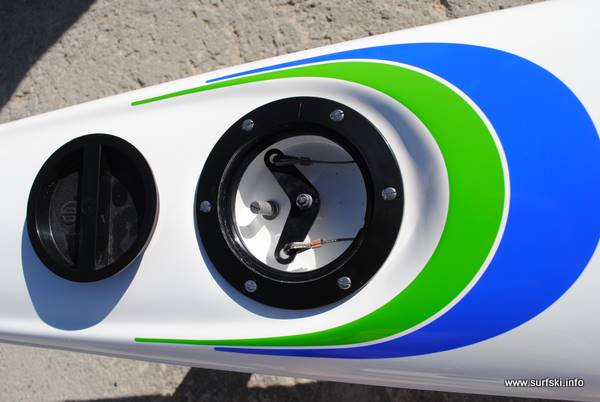
Aluminium rudder shaft & fittings
Red7 Flop?
The first time I set eyes on the ski, it was on the beach at Hout Bay just before a race and I thought, “oh no, they’ve copied the Red7 Surf 70 Pro...” The bow profile looked identical and it had a similar dropped seam.
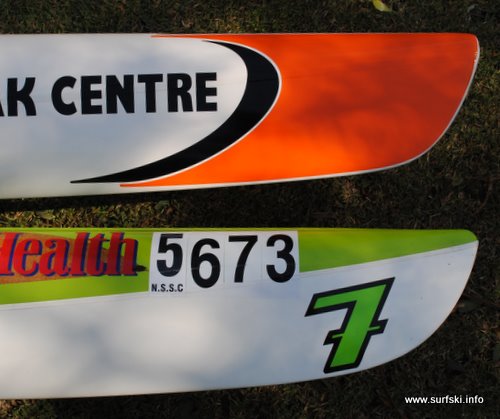
Similar noses - but not identical
And if there’s one thing I hate it’s a flopped boat. Being “inspired” by a previous design is fine in my book – there’s no such thing as an entirely original design, but, heck, this looked as though they’d taken mould right off the Red7.
But as soon as I had the two skis together, the differences were obvious to see. The EOS 660:
- Has a completely different hull cross-section forward of the cockpit
- Has different dimensions (1cm wider at the catch; 1cm wider at the bucket)
- Has more volume
- Has 20mm or so more rocker
- Has completely different steering characteristics (including a very tight turning circle).
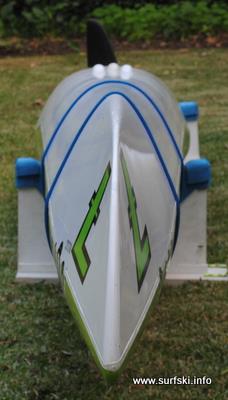
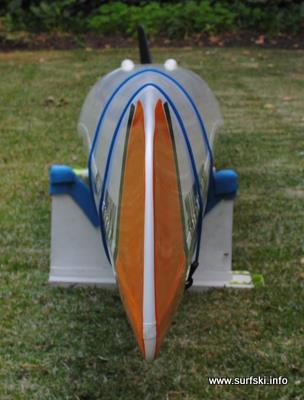
In fact the only characteristics that it shares with the Red7 are the length (6.60m) and a similar nose profile.